
As you walk through downtown Albany (Oregon), among shops and restaurants and vacant storefronts in historic buildings, every so often you’ll see a beautifully handcrafted animal displayed in a front window.
Perhaps you come upon Harriette the frog, wearing a painted-on purple dress and white apron and bloomers, donning a straw hat, and carrying a jar of fireflies under her right front leg. Harriette is perched inside the window at First National Title. Her perfect sheen looks as though a clear topcoat has just been applied.
An alpaca is tucked into a clothing display in front of 1st Hand Seconds, a consignment boutique that benefits a local women & children’s shelter. It’s got a fuzzy tuft of hair above its eyes and wears a red saddle lined with roses. The store’s Chief Operating Officer, Annie Engel, has been looking after the creature for the last two years. “Did you look and see our Taffy?” she asked.
These animals are part of an eclectic menagerie that will soon become the long-awaited Historic Albany Carousel & Museum. It’s a project 15 years in the making that’s been imagined and built entirely by a team of dedicated volunteers – community members who are so invested in this project that even their life stories have been woven into the fabric of its existence.
On the west end of downtown Albany is a brand new octagonal brick building that houses the mechanism onto which the animals will be attached this summer. They’re “going home,” said the leader of the painting team, Gwenn Marchese.
In a few weeks the lights will turn on, music will start to play, and, with any hope, visitors will be lined up to take the first spin.
And nearby business owners and city officials, who’ve planned around the carousel drawing crowds, are invested in its success.

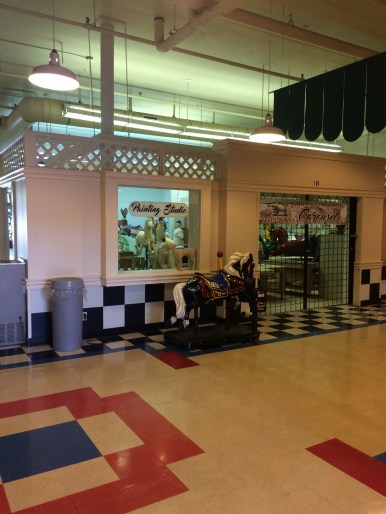
Besides the animals on display around town, several more are getting their final touches a few blocks away at the current carousel museum and gift shop. It’s located in the Two Rivers Market shopping mall downtown, in between Curvy Girl Clothing and Taqueria Alonzo.
They call it a museum, but it’s not really that – yet. It’s more like a studio they’ve outgrown. Sure, there’s a lot to look at, and observers are constantly in and out, but it’s sort of what you’d imagine Santa’s workshop to look like: busy workers at their stations laboring meticulously over toy animals with their woodcarving tools and paints, knick- knacks and hobbyhorses – even a coin-operated pony ride.
But in this workshop the elves are real people and they’ve been working for a long time on one big gift.
It all started with Wendy Kirbey, an Albany resident and a petite blonde woman in her sixties. She’s the founder of the project and the busiest person at the museum.
Kirbey got the idea to embark on this endeavor when she visited Missoula, Montana in 2002 and saw a carousel there that inspired her. “They carved it themselves and put it together; a group of people,” she said. “And I came back with the idea to do that.”
So she got some money, assembled a team, and found a place to start crafting the animals.
“We had a couple that adopted three animals and gave me $22,000,” she said.
That’s what is so unique about the Albany carousel, and attests to the effort that the artists have shown in capturing every detail – the deeply personal stories behind them. Kirbey wanted the animals to be special, and what they offered sponsors was a chance to create a permanent, moving legacy.
Take Fredrick the hare – Kirbey’s own carousel creature. “I lost a child, and his name was Donald Fredrick, and he loved animals,” she said. “He was a very soft-spoken little boy. And my kids loved rabbits. But he’s actually a hare; he’s not a rabbit.
I wanted the animal to be very simple. I wanted him to be brown. Donnie’s favorite book was the Chronicles of Narnia. We lived in the country and the kids used to bring me daffodils and daisies. And so I have a bouquet of daisies on his side saddle, and a book strap with the Chronicles of Narnia, and he’s on his way to the woods,” Kirbey said.
“And that’s in memory of Donnie, but also my kids when they were growing up.”
Harriette the frog was designed to represent late Albany resident Anna H. Murphy. Murphy had a porcelain frog collection, and made her own bloomers as a youngster out of sugar sacks (the bloomers on the frog’s rear end say ‘Sugar’).
According to the Historic Carousel & Museum’s website, Harriette has “12 tadpoles on her apron (six on each side) which represent each of [Murphy’s] 12 pregnancies (she had seven surviving children).”
Taffy the alpaca was a Valentine’s Day present from Ron Reimers to his wife Ingrid, a local couple who once owned an alpaca farm in North Albany. The red roses are a symbol of love.
Harry Lagerstedt is a handsome 91-year-old World War II Navy veteran and a former horticulture professor at Oregon State University, with a slender but strong build, thick pearly white hair and ice blue eyes. He is carving the tail for Buck, the horse he’s sponsored, conceptualized, and built throughout the last year.
Buck is named for Lagerstedt’s late wife’s father’s horse and is carved as if he’s in bucking motion – hence the name.
When Harry came up with the idea for Buck just over a year ago, the 52 figures that outfit the carousel had already been spoken for. To make room, Buck has been given the distinction of holiday horse with an American theme and will make appearances each year for the Fourth of July, and will be displayed in the museum during the off-season. Buck may also serve as a replacement if a “mother horse is injured,” Lagerstedt said.
The horse is adorned with elements in honor of Lagerstedt’s wife. “She was into quilting and so the saddle blanket is a quilt. And all of the squares in the saddle blanket are things that she liked. So everything from crossword puzzles to magpies to beech trees which we grew together, and so on,” he said.
Lagerstedt wants to see the carousel come alive next month. “I hope I live that long!” he joked.

From the beginning, Wendy recruited some of the most talented people in town to help: like Marchese and lead carver Jack Giles. The first lead illustrator was famed artist Terryl Whitlatch, who gained notoriety as the principal creature designer for Star Wars Episode 1 – she designed Jar Jar Binks.
Giles gets up at 4:30am on Sunday mornings and cranks up his New Age music station (he likes Deuter especially) on Pandora in the woodcarving studio just behind his garage. Normally he’d watch the news but he doesn’t really care for it much lately. Sundays are the only days the museum workshop isn’t open and he can get some work done without having to coach the other carvers.
Giles is a creative man of routine; he’s soft-spoken but with authority – an artist, a technician, and a perfectionist.
“I’m the lead carver. Sometimes they call me the head carver but I don’t like using that because then people think I just carve heads,” he said. “Some people call me a master carver but I’m not sure about that. I like lead carver better.”
Giles was once a mockup mechanic for an aircraft company, making wind tunnel models. He’s been carving wood and taking art classes on and off for years.
It didn’t take long to convince him to join the carousel team. “I thought about it for five minutes and said yes,” he said, laughing softly.
He works at the museum on Wednesday nights and some Saturdays, so he sets Sundays aside at home, where he generally does about 8 hours of carving. At his home studio he can get into the real details of a project.
Giles has added to the complexity of the carousel project by making it a labor of love – literally. In a traditional carousel the horses (they’re usually not frogs, Chinook salmon, or mythical creatures like they are in Albany) only have greater detail on the “romance” side – the side that faces outward. Fun fact: Jack says that in England the carousels rotate in the opposite direction so the romance side of an animal is on the other side.
But the Albany carousel animals are finished to a 360-degree view, which takes longer but makes them more unique.
They were also gifted a carousel mechanism by a descendant of the Dentzel family, whose patriarch Gustav Dentzel brought the modern carousel to the states from Germany.
According to Giles, the carousel team has prioritized its legacy. “The bodies of the animals are hollow, so we’ve enclosed some photographs or a genealogy letter from the sponsor inside the body that will never be seen unless, you know, 100 years from now the animal kinda…they have to repair it or get inside,” Giles said.
Each one of these animals takes anywhere from “two to six or seven years,” to carve, he said. And it’s all done by hand. “We don’t use any power tools.”
Giles gets the kiln-dried wood he uses for the animals from the Salem Wood Company. They give him a break on cost.
When he teaches a woodcarving apprentice, it’s a series of lessons in mechanics and artistry – a combination of skills that many of his pupils do not yet possess.
If you’re an inexperienced wood carver, like a majority of the volunteers were in the beginning, Giles will have you start with a rosette that will adorn the outer carousel. If you feel comfortable or show talent, you might be advanced to a more difficult carving project such as hind legs. If your ability or ambition shows even further promise, you’ll be assigned to the hardest projects, like the body of an animal.
He asks his apprentices to visualize what they know about the design. Is the horse going to be in the bucking position (like, say, Harry’s horse Buck)? “I’ll say I want them to go find a picture of a horses leg as close as they can find, in that position.”
At any given time of day, with the exception of Sundays, the volunteer carvers are quietly working, some wearing headphones. Wood curls into blond tendrils at their stations.
Giles and team then attach the carved pieces of the animals with wooden dowels and adjust the position of the limbs or head before making some more intricate cuts. “The pieces are all these odd shapes. You can’t just clamp two pieces of wood,” he said.
Appendages are attached to the body. At this point, finer details emerge – Buck’s leg muscles, the tufts of Taffy’s fur or Henrietta’s hat and dress.
After the creature is fully assembled, it’s on to the paint station on the other half of the crammed workshop, managed by the formidable Marchese, a retired art teacher who’s been the lead painter since she joined the project ten years ago. Giles tries to stay out of her way. “We make the painters look good and the painters make us look good,” he said.

Marchese came to the project through Kirbey. “Wendy and I have been friends for a long time. And I was the one who sat and had breakfast with her and didn’t tell her no,” she said, laughing. “I think there are still a lot of people who say no.”
At her station they start what will likely be a two-year process, beginning with usually three rounds of applying primer and sanding the wood. “Sanding is the most important thing around here,” she said. “Primer and sanding, primer and sanding, and then it’s about eight coats of paint.”
She’s adamant that acrylics wouldn’t work for this kind of project. “The oils permeate the wood; they help preserve it,” Marchese said.
“We stipple everything to break it down into bubbles so it will dry flat,” she said of their technique of painting in tiny dots. “I don’t want to see any brushstrokes.”
They’ve learned a lot throughout this process. “Paint falls off, legs fall off, you know. But you fix them,” she said. “And it gives you a whole lot of experience on what you’re going to have to do down the road. So you just face it calmly and say…well, like Pete says, ‘it’s only wood.’”
Albany has one of the largest concentrations of historical properties and districts recognized by the National Historic Register in the state of Oregon. They’ve been doing things their own way, and keeping it that way, for a long time.
But preserving history can be at odds with urban growth.
City officials have been working to revitalize downtown Albany specifically, and the carousel is planned as an anchor on the west end.
In order to make this long project see reality, there has been a continuous need for funding and space. Thankfully the city, community members and businesses, and the animals’ sponsors have generously donated both of those things.
They want to connect residential Albany to the downtown core through new infrastructure. This past year the city worked with University of Oregon students through a partnership called the Sustainable City Year Program, to find ways to update pedestrian and bike paths, encourage new downtown businesses and clean up park areas.
The carousel has gotten wrapped up into the spirit of a newer, more economically strong Albany, but it is just as much a symbol of the old way of doing things.
Not everyone thinks it’s going to draw the kind of traffic that will support the investments the city has put into these efforts.
Josh Mitchell, a 36-year-old realtor and Albany resident, says it’s a novelty that his kids will be able to enjoy once or twice a year, when they go see summer concerts on the river, but it’s not likely to become a tourist destination.
“Our downtown is so empty that there’s not a lot of foot traffic anyway. And shops are closed on Sundays,” he said.
Besides the western end of downtown where the carousel building sits, near First Street, Mitchell says there just isn’t a lot to do.
“On the east side it’s pretty much non-existent for cute downtown-y things. You don’t have a lot of eateries or coffee shops or boutiques,” he said, adding that even though the city is trying to expand the urban boundary toward the east side of the downtown core, they need more people than the 50,000 residents they currently have to make it work.
Despite this, Mitchell said the housing market is hot. However, he doesn’t see a lot of growth industries to support new folks, and attributes it more to people buying homes in Albany but working, and perhaps living, elsewhere.
Stephanie Siefker, a 25-year-old lifelong Albany resident grew up hearing about ‘the carousel,’ but her interest in the whimsical whirligig began to wane as she reached adulthood and considered it more practically.
“Ever since I can remember I would hear about the animals that were being hand-made, and it was coming, and then it never did,” she said.
Siefker also said that she thinks it’s a nice idea, but attracting people to Albany is going to be difficult. “Most people who live in Albany are going out of town to do stuff – to Salem or Eugene or Portland,” she said.
If they’re not excited about it, Albany residents are mostly apathetic about the whole thing – sometimes they consider it a slight inconvenience.
Siefker said, “It’s going in a beautiful location – but it’s hard to get to, and it’s hard to park.”
Mitchell also brought up parking as a hindrance. Perhaps that’s where the city’s plan for a more pedestrian-friendly way to travel downtown will be especially useful.
The Albany carousel isn’t even the only one in the area. They’ve got competition. Up in Salem, the state capitol, and Albany’s larger neighbor to the north, is the riverfront carousel, erected in 2001. When people talk about it they scoff at the thought that it even compares to what Albany has put together. It’s only got horses, and 12 fewer animals to boot.
And, as with any team endeavor, personalities can get in the way.
“There’s been…everybody here is a volunteer except for one employee, so when you have 25 opinions or 30 different opinions, yes we have had disagreements over many different things,” Kirbey said. “But we’ve stayed at the table long enough until we worked it out.”
Some people have left because they did not like what we were doing or how we were doing it. That has not been a big amount of people, but a few,” she said. “And then people’s lives change. Some people have left because they moved, or they had to stay home and take care of their husband or their wife.” Most of the volunteer crew is made up of retirees.
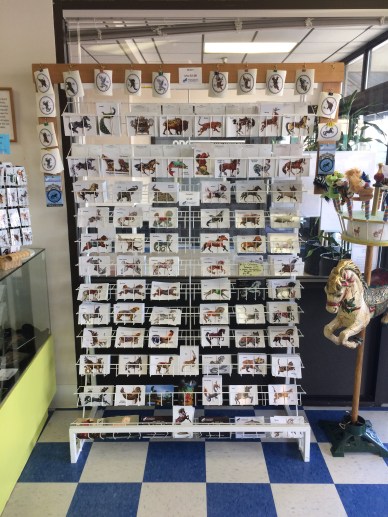
Skye Sandborgh is the gift shop manager and volunteer coordinator who will supervise the physical move from the current space to the official building. She only recently came on to the project.
“Because the building is 22,000 square feet we definitely need more volunteers and more organization and that’s what I’m here to do,” she said.
One of the younger volunteers, at 37, the tall, chestnut ponytailed mother of two is also bringing the carousel project into the digital age by creating a volunteer database. She wants to be able to track hours accurately and keep contact information like email addresses and schedules easy to find. Until now, everything has been maintained in an old notebook.
She thinks it’s important to show appreciation to all the people who’ve made this a reality.
“They’re all volunteering for the passion of the project but it’s nice to get some recognition as well,” she said.
Assembling a team of movers has taken some outside help. Many community organizations have offered help with the physical move. Businesses like Home Depot have set up a team to help move boxes and animals and other items at no cost.
They’ve got specialists on hand for the more difficult parts. “We have people who have expertise with the carousel mechanism and installing it,” she said. “But until we actually move it in there and actually get it set up we won’t know. So we’re hoping it all goes smoothly.
I think it’s pulled the community together in a good way to work on something not just for fun, but in a large part that’s what it is,” she said. “It’s a nonprofit so it’s not trying to compete with businesses. It’s trying to help businesses and partner with them. The building is gorgeous and hopefully it will bring in more people to the downtown area to visit and experience what Albany has to offer.”
The building will house the museum, workshop, gift shop, and of course the carousel itself, and will have party rooms for birthdays and weddings. In fact, Annie at 1st Hand Seconds has already booked the venue for their yearly gala coming up next February.
Hopefully it will attract the high volume of visitors that nearby businesses are expecting. According to gift shop volunteer Frances Clause, that shouldn’t be a problem.
“People like myself who are absolute fools for carousels plan vacations around them,” she said.
Even once the carousel is up and running, there will still be animals being conceived, a local citizen might be picking up a woodcarving tool for the first time, or a painter will be adding final touches.
The carousel is a living entity, one that is constantly changing and growing – and that keeps the community working together.
“I think there’s still going to be a lot of fun stuff to be done. We’re not going to have all the animals carved. There’s still a lot of work to do,” Kirbey said.
“When I start my next carousel, which I’m not, it’ll be much easier.”
Opening day is set for 10:00 a.m. on Tuesday, August 15, 2017.
UPDATE: The Albany Carousel is open!
 Josie Fey
Leave a comment