
Artist Sandow Birk’s depictions of the words of the Qu’ran juxtaposed with images of American culture result in a marriage of East and West that highlights universal ideas about life.
“In the name of God, the compassionate, the merciful.”

When you enter the Jordan Schnitzer Museum of Art on a weekday afternoon, you’re likely to encounter some hustle and bustle. Groups of students gather together for tours, retired professionals stroll through at a leisurely pace, and the person at the front desk directs visitors.
Things begin to quiet down when you reach the Barker Gallery upstairs. The featured exhibit calls for reverence. It’s an unconventional and thorough display of the pages of the holy book of Islam, the Qu’ran.
California artist Sandow Birk’s “American Qu’ran” show brings together themes from East and West in a collection of hand-scripted chapters of the religious text juxtaposed onto his colorful painted illustrations of iconic US settings and scenes.
The idea for the project was born from the terrorist attack in New York City on Sept. 11, 2001. After the tragic event, Birk became interested in Islam and wanted to understand more about the faith and its followers. He traveled to Muslim countries, met with people to find common ground, and absorbed what he could of the culture.
What came out of that exploration is this project, which took him more than a decade to complete and consists of approximately 200 individual pieces. That he produced each one by hand is an impressive feat.
It’s hard not to notice the intricacy with which each painting has been crafted, and the details of every scene. The frames holding the artworks are landscape oriented and roughly standard poster size. Within those frames is a carefully applied, embellished and fine lined border on paper with an off-white color resembling the aging pages of historical books.
The border outlines meticulously painted images of ubiquitous scenes and people of Americana – women giving birth in hospitals, groups of people going to church, movie sets in Los Angeles, backyard barbecues, and police officers on a call – just to name a few. Congruent verses of text from the Qu’ran, inscribed on rectangular boxes, and written in English, obstruct the images and bring context to the story of those pictures. As in the book, most chapters begin with the words, “in the name of God, the compassionate, the merciful.”
One of the pieces shows an image of a man sitting in a cubicle, with unkempt hair and a crooked tie, slouching in his swivel-chair – the epitome of a stressed out office worker. The accompanying chapter is titled, “The Inevitable.”
Faith as an overall theme came up in some of the paintings. America is a melting pot of individuals and their religious and spiritual cultures and this was a deliberate representation of those differences in a place where they are generally respected and protected. There were images of Christian churches and Orthodox Jews, along with pictures of Muslims praying.
War and conflict are represented in different ways. One of the paintings depicted American soldiers on deployment in what looked like the Middle East – as evidenced by the mosque on a sandy area in the background. This depiction of our continued conflict with those nations was a big part of the impetus for the project itself. At home, images of conflict exist in the streets between police officers and their communities.
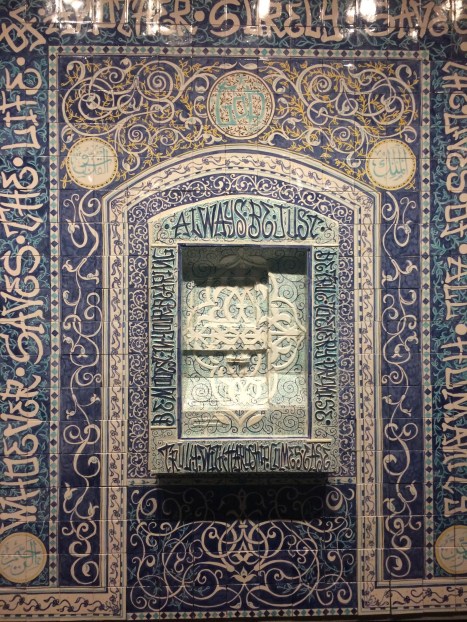
The peripheral walls of this exhibit hall are painted a light gray, allowing the paintings to become the primary focus. Structures are set up along the center of the room to display more of the drawings, which were painted a cerulean or royal blue.
Breaking up some of the collection was the addition of a few elaborate blue and white ceramic wall pieces influenced by Middle Eastern architecture and design. One was about six feet wide and ran from floor to ceiling. Birk and his wife, Elyse Pignolet (who’s also a professional artist), collaborated on these immaculate works of art.
For those interested in seeing the original text, in a small adjacent room was a glass case containing a handful of antique religious texts, including a Qu’ran written in the original Arabic.
What might be a drawback is the exhibit’s volume and the time it takes to read each piece. You’ll want to go when you have a few hours to burn, or perhaps make repeated visits.
“American Qu’ran” is an artful and accommodating gateway into what might be considered mysterious territory by those unfamiliar with, or even apprehensive of, the Muslim faith. It uses the wisdom of the words to contextualize everyday visions of life in America, and shines a light on the humanity that is universal no matter what religion, if any, you follow.
 Josie Fey
Leave a comment